



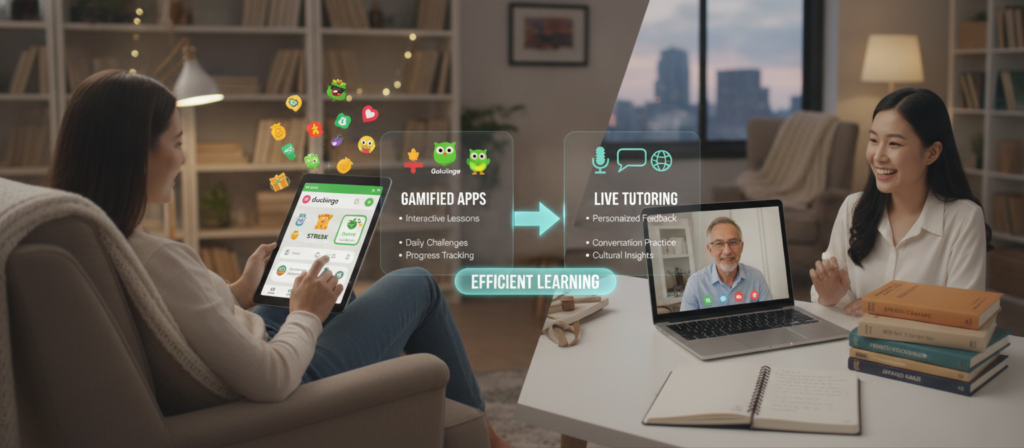
Ever wonder why you’ve completed hundreds of app-based exercises but still freeze during a real conversation? This gap between practice and actual communication frustrates many language learners. It shows that tapping icons and speaking with confidence do not always develop at the same pace.
Two popular approaches aim to bridge this gap. Duolingo rewards daily practice with points and streaks, while private online lessons connect you with a real teacher who can correct your grammar and pronunciation in real time. Both methods can support language learning, but they serve different goals.
This guide compares the key differences between these two language learning methods. You’ll see how cost, speaking ability, feedback quality, and scheduling flexibility compare side by side.
By the end, you’ll have a clearer idea of which approach best fits your goals, budget, and preferred way of learning.
Key Takeaways
- Language-learning apps can build vocabulary and daily habits but offer limited real conversation practice.
- Private lessons provide personalized feedback that can improve speaking confidence and grammatical accuracy.
- Costs differ significantly, so consider your budget alongside your goals and desired level of progress.
- Flexibility varies between self-paced apps and scheduled teacher-led sessions.
- Combining self-study with private instruction can produce more well-rounded results.
- Your specific goals, whether related to travel, work, exams, or personal interest, should guide your choice.
Duolingo and Private Online Lessons: Two Different Paths to Language Learning
Duolingo and private online lessons are two common ways to study a language. The Duolingo app uses gamified language learning to encourage regular practice. Private online language lessons offer real-time interaction with a teacher who can tailor instruction to the learner. Both methods can be useful, but they develop different skills.
What Duolingo Offers Language Learners
Duolingo is known for making practice accessible. It breaks lessons into short, manageable exercises. Learners can earn points, maintain streaks, and take part in app-based challenges.
This gamified language learning model focuses on regular practice. A free tier is available, while paid plans provide additional features. The app can be useful for reviewing vocabulary, practising basic grammar, and developing a daily study habit.
However, an app alone may not provide enough spontaneous conversation practice or detailed feedback to meet every learner’s fluency goals.
What Private Online Language Lessons Offer
Private online lessons provide direct interaction with an online language teacher who can give feedback and correct errors during the lesson. This more closely reflects the demands of real-life communication.
A qualified teacher can explain more than vocabulary. Lessons may cover cultural context, idioms, pronunciation, tone, and appropriate language for different situations. One-on-one language lessons can focus on individual goals, whether a learner is preparing for work, travel, an exam, or conversations with family.
These lessons can adapt to your pace, interests, strengths, and areas for improvement. At Your Native Teacher, learners can work online with qualified teachers and receive personalised guidance based on their goals.
Duolingo vs Online Lessons: Comparing the Key Factors That Matter
To compare Duolingo with private online lessons, it helps to consider cost, speaking confidence, feedback quality, flexibility, and long-term retention.
Cost and Overall Value
Duolingo offers a free tier, while the cost and features of its paid plans may vary. Private online lessons usually cost more because they involve dedicated time with a teacher.
Cost is only one part of the decision. When comparing the cost of language learning with the quality of support provided, private lessons may offer greater value for learners who need speaking practice, targeted explanations, or help with specific goals.
Apps can be useful for vocabulary drills and regular review, while teacher-led lessons provide personalised guidance that an automated tool cannot fully replicate.
| Factor | Duolingo | Private Online Lessons |
|---|---|---|
| Cost | Free tier; paid plans vary | Varies by teacher, lesson duration, and frequency |
| Feedback Speed | Instant and automated | Immediate and teacher-led |
| Speaking Practice | Limited voice exercises | Live conversational practice |
| Best For | Vocabulary review and habit-building | Speaking, accuracy, and personalised goals |
Speaking Confidence and Real-World Communication
Speaking fluency develops through active communication as well as vocabulary and grammar practice. Duolingo’s voice exercises can provide some pronunciation practice, but they do not fully reproduce the unpredictability of a real conversation.
Private online lessons offer real-time interaction. You speak with a person who can respond naturally, ask follow-up questions, and adjust the difficulty of the conversation. This helps develop the ability to think and react in the target language.
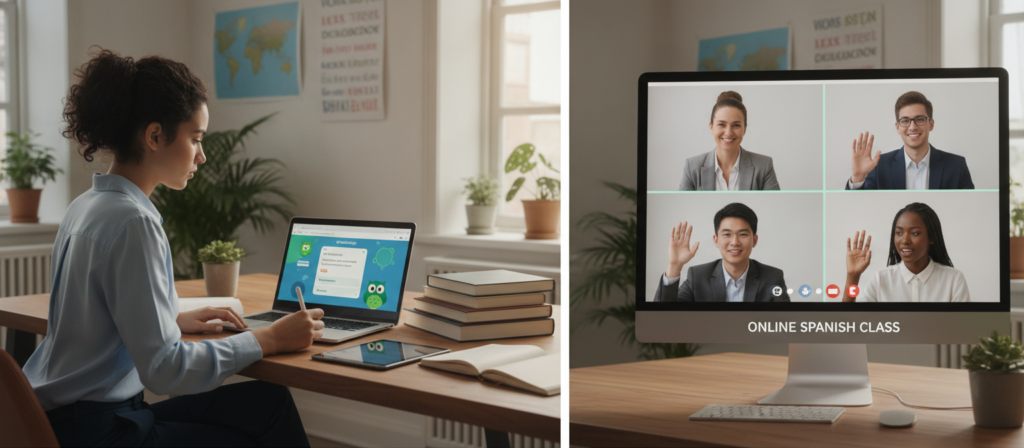
This live interaction prepares you for real-world conversations. Online language classes with a teacher can help you develop conversational reflexes and become more comfortable expressing your ideas.
Personalized Feedback and Correction
Duolingo’s feedback system is automated. It can indicate whether an answer is accepted, but it may not always explain the underlying problem in a way that addresses an individual learner’s confusion.
Private lessons offer personalized feedback. A teacher can listen to your pronunciation, identify recurring mistakes, and explain a point in a way that suits how you learn. This can reveal details that automated exercises may miss, such as a subtle vowel sound or an inappropriate word choice.
Timely correction can help you understand why a mistake occurred instead of simply memorising the correct answer.
Flexibility, Structure, and Learning Pace
Duolingo offers considerable convenience. You can practise at almost any time, making it easier to fit short study sessions into a busy schedule. This flexible learning schedule can support a consistent daily habit.
Private lessons require scheduled attendance but provide more structure. A teacher can create a plan based on your goals and adjust the pace according to your progress. Regular sessions can also provide accountability.
If you prefer completely independent study, an app may suit your routine. If you need structure, live speaking practice, or individual feedback, private lessons may be the better fit.
Long-Term Fluency and Retention
Short-term progress can be motivating, but lasting language learning fluency requires varied practice. Some app users eventually reach a point where they recognise many words but still find it difficult to form sentences naturally in conversation.
Private lessons can address this problem through consistent, personalised instruction. A teacher can revisit weak areas, reinforce grammar in context, and introduce progressively more challenging conversations.
For learners aiming to communicate confidently, structured guidance from a real teacher can complement app-based practice and help them work through plateaus.
Conclusion
Duolingo can be a useful addition to a daily study routine. It supports habit-building, vocabulary review, and short periods of independent practice. However, it may not be sufficient on its own for learners who need spontaneous conversation skills.
When comparing Duolingo vs online lessons, speaking practice and personalised feedback are among the most important differences. A private teacher can correct your pronunciation, adapt the lesson to your pace, and help you prepare for situations that matter to you.
Many learners choose to combine the two approaches. An app can support vocabulary review between lessons, while private instruction provides structured speaking practice and individual guidance.
If your goal is casual exposure to a language, app-based study may meet your immediate needs. If you want to use the language confidently for work, travel, exams, or everyday communication, regular lessons with a qualified teacher may offer a clearer path forward. Your Native Teacher provides live online lessons tailored to individual learning goals.
Think about what you want to achieve, how much speaking practice you need, and what type of support helps you stay consistent. The best learning plan is the one that matches those needs.